

What Is Makhmaria?
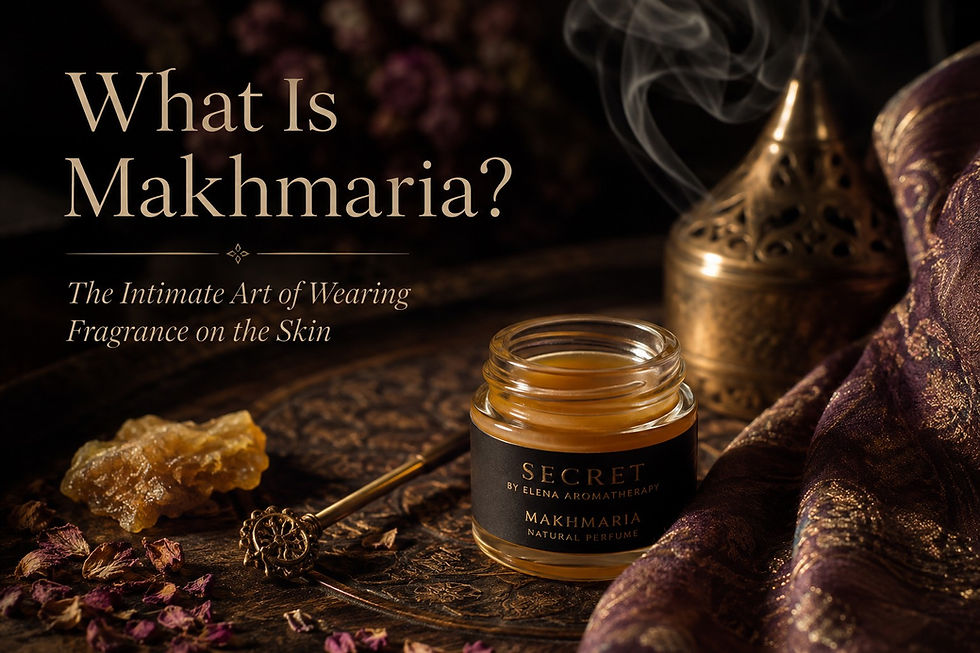
The Intimate Art of Wearing Fragrance on the Skin
Some fragrances announce your arrival.
Makhmaria does something very different.
It waits for someone to come closer.
It is not experienced in quite the same way as a perfume sprayed into the air. Makhmaria (also transliterated as macmaria) is touched directly onto the body, where warmth, movement and skin become part of the way the fragrance unfolds.
There is something almost secretive about this way of wearing scent.
You don't step into a cloud of perfume.
You touch it to your skin.
You wait.
And gradually, the fragrance begins to reveal itself.
For me, discovering makhmaria opened the door to a much larger question:
What if perfume is not only something we smell, but something we experience through the body?
Discovering Another Fragrance Tradition
My own path into scent began with aromatherapy, olfactotherapy and natural perfumery.
I learned to work with essential oils, absolutes, botanical extracts and natural aromatic materials. I studied how we perceive aroma, how materials interact in a composition, and how fragrance can affect our emotional experience.
But over time I became increasingly curious about another world of perfumery.
Attars.
Makhmarias.
Resins and incense.
Saffron, sandalwood, oud and musk.
Aromatic materials and traditions whose stories extend far beyond the modern perfume bottle.
I became fascinated not only by what these materials smelled like, but by how people traditionally lived with fragrance — on the body, in clothing, in the home, in incense and in personal ritual.
This curiosity eventually led me to the work of perfumer and educator Yasin Anvari, founder of Perfecta Laboratory.
Fragrance, Purity and the Body
One idea from Yasin's teaching stayed with me especially strongly.
In one of his webinars, he spoke about fragrance within a larger understanding of purity — the clean body, the inner self, and one's actions — and about the importance of using fragrance in relationship with this whole.
I found this idea fascinating.
Perfume was no longer simply the final accessory we put on before leaving the house.
Fragrance could begin with the body itself.
With cleanliness.
With attention.
With the places on the body where an aromatic preparation is applied.
And with the way scent changes as that body warms, breathes and moves.
This perspective also helped me understand why applying fragrance to clean skin can feel so different from simply spraying perfume around ourselves.
Aromatic preparations can be touched to different areas of the body — the wrists, inner elbows, neck, behind the knees, ankles and other warm areas — allowing scent to emerge from several subtle points rather than from one large cloud.
The body is no longer simply a surface holding perfume.
The body participates in the fragrance.
Yasin's own published teaching places makhmaria within his study of early fragrance traditions and connects working with aroma to preparation and perception of the body. His professional seminar Map of the Aromatic Body, for example, specifically addresses preparation of the body and the application and evaluation of aromatic materials on it.
Learning from Yasin Anvari
Yasin's work has become an important influence on my exploration of natural perfumery.
What attracts me is not simply a collection of formulas or exotic ingredients. It is his willingness to look far beyond modern commercial perfume and investigate the cultures, materials and practices surrounding fragrance.
On his website, Yasin describes years of expeditions and pilgrimages through Iran, Lebanon, Egypt, Istanbul, Mesopotamia and Italy, studying traditional culture and meeting producers of aromatic materials, perfumers and other practitioners. He later founded his aroma school and developed his own methodology for studying and describing aromatic substances.
More recently, he published the digital edition of his book Золотые нити аромата (which could be translated as Golden Threads of Aroma), which I am currently reading.
His lectures, programs, writings and fragrances continue to encourage my curiosity about rare natural materials and older ways of experiencing scent.
But inspiration is not imitation.
I am not trying to reproduce Yasin's compositions or recreate another perfumer's system.
His work makes me want to investigate for myself.
To smell unfamiliar materials.
To understand them.
To experiment.
To listen to what happens when they meet other materials and, eventually, the human body.
Between East and West
This has also made me think more deeply about my own direction as a natural perfumer.
My education has given me a foundation in European approaches to aromatherapy, olfactotherapy and natural perfumery.
My exploration of Eastern fragrance traditions is showing me another relationship with scent — one that includes attars, makhmarias, incense, resins, aromatic body preparations and materials with centuries of cultural history.
I don't want to choose one world and reject the other.
I want to learn from both.
I want to understand what can happen when these different ways of knowing aromatic materials meet.
Not to reproduce the past.
Not to copy someone else's tradition.
But to allow that knowledge to inform experimentation and, eventually, to find my own language of fragrance.
And this is where SECRET began.
From Curiosity to SECRET
When I started creating SECRET, I wasn't trying to put ordinary perfume into a little jar.
I wanted something warm.
Sensual.
Floral and resinous.
Softly animalic.
Something intimate rather than loud.
A fragrance that could remain close to the body, yet occasionally rise from warm skin and make its presence known again.
I found myself drawn to beautiful natural materials: Indian sandalwood, jasmine sambac, rose absolute, frankincense, labdanum, patchouli, vanilla and natural civet musk.
But as I worked, something unexpected happened.
I became less interested in asking:
“How strong is this perfume?”
And more interested in asking:
“How does this perfume feel on different parts of my body?”
Learning to Listen to Fragrance with the Body
I began wearing SECRET on different areas of my skin and observing it.
Not just smelling my wrist every few minutes.
Living with it.
Moving.
Working.
Walking.
Forgetting about it.
And then suddenly noticing it again.
Sometimes the fragrance seemed to have retreated almost completely.
Then I would turn my head or lift an arm and catch it again.
A little jasmine.
Warm resin.
Creamy sandalwood.
Something darker and more animalic underneath.
Then it disappeared.
And later it returned.
I found this strangely beautiful.
It began to feel less like a perfume continuously broadcasting its presence and more like a quiet conversation between aromatic materials, warmth and skin.
Perhaps fragrance doesn't always need to speak.
Sometimes it can whisper.
Does Perfume Always Need to Project?
We often judge modern perfume by performance.
How strong is it?
How far does it project?
How many hours does it last?
Will other people notice it?
Those are perfectly reasonable questions.
But creating SECRET made me wonder whether sensuality might sometimes work in exactly the opposite direction.
Perhaps the most intimate fragrance doesn't need to fill the room.
Perhaps it can belong first to the person wearing it.
And then, perhaps, to someone who comes close enough to discover it.
That is the world I want SECRET to inhabit.
Not a perfume that enters the room before you do.
A perfume that waits on the skin to be discovered.
The Ritual of Touch
There is another reason I have become so fascinated with makhmaria.
The gesture itself is different.
There is no spray.
No cloud between the bottle and your body.
You open a small jar.
Take a tiny amount with your fingertip.
Touch it to clean, warm skin.
And wait.
It is such a simple act, but it changes your attention.
You notice the skin.
The warmth of your neck.
The inside of your wrist.
The bend of your elbow.
The movement of your body.
And the fragrance that slowly begins to emerge from those places.
Touch.
Warmth.
Skin.
Scent.
Time.
For me, applying SECRET has gradually become something more than “putting on perfume.”
It has become a small ritual.
SECRET Is Taking Shape
SECRET is now in the final stages of preparation in my Connecticut studio.
It will be handcrafted in very small batches using carefully selected natural aromatic materials.
I am also preparing a small discovery size, so that it will be possible to experience SECRET on your own skin before deciding whether you want the full size.
Because I don't think this fragrance can really be understood from a list of notes.
It needs skin.
It needs warmth.
It needs movement.
And it needs time.
Touch it.
Wear it.
Forget about it for a moment.
And then wait for it to find you again.
Perhaps your skin will tell a slightly different story than mine.
And that, to me, is part of the beauty of perfume.
I will share more about SECRET soon.
Until then, I will leave you with the question that has followed me throughout its creation:
What if the most sensual fragrance isn't the one everyone notices —
but the one someone has to come closer to discover?
— Elena Aromatherapy

Comments